

Now we are seven and all systems are go. Click http://www.stockbridgeupdates.com and in upper right corner, subscribe or leave us a comment. Find our complete archive from the first issue in August 2020 through April 15, 2026. Search an old article, read or reread them, and of course, take another look at all those fabulous photographs. if you would like to support Stockbridge Updates, go to VENMO @carole-owens-6 (no caps) or mail a check to P. O. Box 1072, Stockbridge, MA. 01262. If you like this issue, pass it on.
IN THIS ISSUE: VOL. VII NO. 07 04/01/2026
by Brian Bell
by Sally Underwood
by Lisa and David Pugh
by Carole Owens , Executive Editor
Perspective
A BIT OF BSO HISTORY
By Brian Bell
In April of 1918, the 83-year-old Henry Lee Higginson’s failing health and finances forced him to resign the stewardship of the Boston Symphony at probably the most critical moment of the orchestra’s history. With the conductor Karl Muck arrested, and a large portion of the musicians German or from the Austro-Hungarian empire, guidance after the turmoil of the First World War had to come from somewhere else.
In May of 1918, the Boston Symphony was incorporated, a board created from some of Boston’s most prominent families, with Frederick P. Cabot as President and Frederick Lowell as Treasurer. The search for a new conductor went about as poorly as can be imagined. Overtures to candidates were telegraphed to the press as the candidates themselves were reached.
A conductor was secured just six weeks before the season was to begin, a relative unknown, Henri Rabaud. The only problem was that Rabaud was in France, and with the war still raging, getting on a transatlantic ship was not in the cards. It fell to Pierre Monteux (under contract for French repertoire at the Metropolitan Opera) to audition players for the many openings created by departing German speaking players that autumn, and with no Rabaud, Monteux opened the season after a flu epidemic had closed the city for a month. Rabaud finally showed up in mid-November, and promptly departed at the end of March, leaving the newly installed board the task of finding another conductor in as many seasons. Fortunately Monteux was able to wrest himself from the Metropolitan Opera, but an even more serious issue came to the fore. Since Higginson’s resignation, the musician’s compensation did not begin to cover what was offered in earlier years, and the board’s ham-handedness in dealing with the players resulted in a strike before a Saturday night concert in March of 1920. Nearly half of the orchestra was fired on the spot. Monteux had to reorganize the orchestra for a second time. Thus concluded the second season without the sure and steady hand of Henry Lee Higginson.
Without Higginson to pay the bills, a board of trustees was regarded as the only realistic means of keeping an orchestra financially viable. This was how the Chicago Symphony was organized in 1891, and after more than 67 years as a self-governed cooperative (from 1842 to 1909), the musicians of the New York Philharmonic established a board of trustees. But this arrangement is far from ideal when it comes to artistic integrity. This past century is chock full of instances where musically clueless board members made decisions that are complete head scratchers, even without the benefit of hindsight. My personal favorite is the dismissal by the Philadelphia Orchestra of Leopold Stokowski after a quarter of a century of playing too much contemporary music. They haven’t had it so good since. The BSO board cannot claim complete credit for several steps forward in the past century. The Berkshire Music Festival was in its third season before the Boston Symphony was contacted, and only with Serge Koussevitzky’s insistence did the orchestra journey forth. The board had nothing to do with the creation of the Shed, as this was the purview of the Berkshire Symphonic Festival and Miss Gertrude Robinson Smith. Only in 1946 did the festival and the Shed become part of the Boston Symphony, when Smith and the Berkshire Festival generously donated the Shed and ceased existence. Then there is the matter of union representation. Higginson did not deal with the union during his lifetime because of the union’s insistence that the membership be drawn from their local, in other words, from Boston rather from anywhere in the world. Higginson made up for this lack of representation by compensating them far better than they would find elsewhere. Getting the Boston Symphony into the musician’s union was not an action by the trustees, indeed it was the death of BSO trustee Ernest Dane in April 1942 that allowed Serge Koussevitzky to spring into action. It paved the way for Koussevitzky’s personal negotiations with Union president Joseph Petrillo, and Petrillo’s altering of the union bylaws to allow for orchestras to hire from outside their locals, that got the BSO to sign on the dotted line.

by Brian Bell
Perspective
A Proposal of a Number of Issues to the Citizens of Stockbridge
By Sally Underwood
With the loss of biodiversity and the risk of losing @432 species to extinction, why do we continue to allow the proliferation of toxic chemicals to maintain our homes, lawns and roadways? At Town Meeting in May of 1998, citizens of Stockbridge voted to disallow the use of herbicides and pesticides within 200′ of a wetland resource in our Rights-of-Way.
While this is a start, we need to think whenever we use toxic chemicals. The cumulative effects of their use are too often ignored. Products such as Rodeo (glyphosate) kill far beyond their intended targets. Remember the old song about “I knew an old lady who swallowed a fly…”? Things eat other things. It all goes up the food chain. D-con, another popular product, also causes unintended consequences. The mouse eats the D-con, goes outside to die, gets eaten by a hawk, your cat, your dog… resulting in illness, possible death. When you bring your dog into the vet’s office with unspecified symptoms, the vet will often ask if it could have ingested D-con.
Stocking fish stocks the state’s coffers through fishing licenses, but what does it mean for the native species? The native brook trout vies for the same resources as the invaders.
Who mows your lawn, works in your local stores and restaurants, plows your driveway, fixes your roadways, clogged sink or porch stairs, saves your burning building, keeps us all safe? Average, often extraordinary, people doing essential work. Why do we not prioritize where they can afford to live in our Town? Yes, it’s great to grow our economy, but if we don’t have the local workforce to support our infrastructure, it will all collapse. DeSisto and Elm Court boast jobs and taxes, but where will the workers come from and where will they live? Jack Fitzpatrick recognized that and provided housing for many of his workers.
What makes Stockbridge Stockbridge? Why do thousands of people come here from all over the world? I believe it’s the essential look and feel of the Town. We must preserve that! If we lose our open spaces and the Rockwellian vibe, we will lose everything. We have an unique blend of a small-town New England village that also offers some of the most outstanding cultural venues, scenic beauty, and historic places in the world.
Conservation and preservation of both our natural and cultural worlds will ensure that we don’t lose everything we hold so dear.

by Sally Underwood
Events
Events
Berkshire Theatre Group will present 1776 directed by David Atkins and presented at the Colonial Theatre.
Casting: Berkshire Theatre Group seeks local non-Equity actors of all ethnicities, gender identities and backgrounds for its upcoming production of 1776. This is a non-Equity production. A weekly travel stipend will be provided. High school, college and pre-professional actors are encouraged to submit.
Submission Instructions: Please submit the following via an unlisted video link (YouTube, Vimeo, Google Drive or similar platform): One (1) short classical or contemporary dramatic monologue or One (1) song demonstrating vocal and acting range. Total submission time should not exceed two (2) minutes. Selections from 1776 are welcome. Please ensure your link permissions allow viewing without requiring access requests. Send submissions to: auditions@berkshiretheatre.orgDeadline: Friday, March 27 at 5pm
For questions or assistance with recording or submitting your audition, please contact: auditions@berkshiretheatre.org
New Marlborough Meeting House announces their 2026 Season will include:
Tales of New Marlborough, June 20, offers an evening of local storytelling celebrating the voices and experiences that make the town unique.
One Town, One Read, June 27, an afternoon devoted to shared reading and discussion. This year’s program focuses on Daniel Mason’s bestselling novel Northwoods.
Celebration of the Nation’s 250th Anniversary, July 4th, will feature readings from the Declaration of Independence by local residents, patriotic music, and complimentary coffee and pastries. The event is co-sponsored by the New Marlborough Historical Society and American Legion Post 350.
Grammy-winning violin-and-cello duo Arkai, July 18, performing their innovative and genre-defying music. Arkai returns to New Marlborough following their acclaimed 2024 appearance and the recent Grammy Award for their album Brightside.
Aimée Allen Quartet, July 25, brings an afternoon of expressive jazz. Allen, whose latest album Love & the Catalyst was nominated for a NAACP Image Award for Outstanding Jazz Album – Vocal, blends jazz standards, bossa nova, and original composition
New York Times opinion columnist Michelle Goldberg, August 1, appears in conversation with poet and essayist Katha Pollitt to discuss the current political moment and the future of American democracy.
Historian David Nasaw, August 8. will appear in conversation with longtime WAMC public radio host Joe Donahue to discuss Nasaw’s recent book The Wounded Generation, which explores the impact of World War II on the soldiers who fought in it.
The Mammals, August 22, bring their energetic blend of Hudson Valley folk traditions, string-band sound, and socially engaged songwriting.
Manon Hutton-DeWys, September 19, appears with two outstanding musicians in an afternoon of some of the most exciting piano trios in the classical repertoire.
Itay Dayan Band, September 26, led by Boston-based clarinetist Itay Dayan, brings klezmer music to the New Marlborough Meeting House.
The season concludes on October 3 with a classical program featuring violinist Grant Houston and pianist Dina Vainshtein performing a program of American music.
All events take place Saturday at 4:30pm except Ta and the July 4th celebration (10am). For more information: www.nmmeetinghouse.org
The League of Women Voters announces the regional theater production of Representation and How to Get it at the Monterey Meeting House.
Representation and How to Get it will have two performances: at 7 pm on Friday, April 3rd, and 2 pm on Saturday, April 4th. The Meeting House in the center of Monterey.
This is a one-woman play that focuses on suffragist and abolitionist, Julia Ward Howe, as she prepares for a speech on an early morning in the late 1800’s. She sees an America that is built for some but not all and demands to know, “What are we going to do about it?” The play and panel discussion is about an hour. The panel consists of female politicians plus a PBS Newshour journalist. For more information, go to the Monterey Meeting House website: https://montereymeetinghouse.org/

Perspective
Making Change
By Lisa and David Pugh
With all that is happening in our world today, it is easy to lose faith in government. We have our rights being trampled on, science being denied, regulations to help our planet being dismissed and our neighbors near and far crying out for help and for justice. These events feel overwhelming and hopefully we all do our part to resist and work to bring about change.
In our small corner of the world here in Dalton, we have been engaged in community activism to protect our neighborhoods from excessive dust created by a company that has not responded to pleas or orders to properly clean up their property and change their practices. We recently secured a historic victory that was the result of long hours, research, and community advocacy. When I say “we” I mean the members of the Dalton Clean Air Coalition, along with other concerned citizens and town volunteers.
Initially, a small group canvassed our neighborhood and were able to rally over 100 citizens to a Board of Health meeting last February. We had been directed by town officials to start there. We were bounced from one board to another. Each board seemed to be working within its own silo, without information flowing between them. While each board was receptive to our concerns, we were told a different board had the authority to help.
We held a neighborhood meeting and collected over 450 signatures on a petition demanding an end to the dust and we formally created the Dalton Clean Air Coalition. We did our homework, we found town bylaws, state and federal regulations that supported our case. We contacted the DEP, our state representative, and organizations on the other side of the state dealing with the same issues. We uncovered a long history of discord between the town and the company. We found old permits, legal proceedings, agreements, and maps. We created packets of information that were distributed to town officials and town boards showing decades of issues with the company and highlighting the laws that protected our neighborhood. Our constant presence at Select, Planning and Health board meetings sent the message we would not be deterred. We canvassed the neighborhood again and held another community meeting. We contacted media outlets to bring awareness to our cause. We also made buttons and placed large signs around town as well as smaller yard signs.
While the town shared responsibility for the lack of oversight, we knew we needed to turn our anger into productive conversations. We always thanked the boards for the work they were doing while also pushing for accountability. We wanted accountability from the boards as well as from the company. We reminded the boards of the control they had over the issue and that they needed to reclaim. We called upon them to act with the same sense of urgency we had. We desired to work together but we were also very firm that anything less than decisive action on the illegal strip mining and the need to mitigate it would be unacceptable.
“The wheels of government turn slowly” is a cliche for a reason. We urged the then-Town Manager to bring the boards together so they could all talk to work out a solution. After several months of advocating consistently, the town Clean Air Committee was formed. This Committee has representatives from relevant town boards, the Clean Air Coalition, and concerned citizens. This committee meets to review the work from each board and discuss next steps. Boards are now sharing information and working collaboratively.
Often people voiced support, but said, “Good luck, you will never stop them.”
We heard the voices of residents as far back as 1976 and we knew we would keep going. When you arm yourself with knowledge, facts, and the law, you have to give it all you can. We need to trust that our government is protecting the rights of its citizens and enforcing rules with consistency. The citizens are the town and when the town government isn’t working, you help.
Our group has brought people together to solve this issue, and we are grateful for the efforts the town is now undertaking. This has been a huge effort on the part of many, but the town is finally controlling the narrative and enforcing accountability.
We are not naïve. This fight is not over but we have won a huge victory with this permit being denied. We persevered and worked to gain the support of town boards and the community and we prevailed.

by Lisa and David Pugh
News
Notes from Sewer and Water Commission (SWC), March 10, 2026, Hybrid meeting
Michael Canales presented the draft budget and his recommendations as follows:
Sewer is operating at 99% which means expenses and the amount collected are about even and the annual surplus is just $5000. The Commonwealth does not allow sewer or water to “carry balances” but Canales still wants what he calls a “net positive” surplus. Canales reported that 99% is “cutting it too close.” Therefore, he recommends a rate increase that will result in a larger surplus. If rates are raised 7.5% the surplus will be $40,000. Followed by a 2% rate increase annually. 7.5% would reduce the percentage of cost to income from 99% to 92%.
However, the energy cost for sewer is $55,000 annually. As a Climate Leader, Stockbridge has applied for a $1million grant for solar. If it is received, then sewer annual costs will be reduced $55,000 and water annual energy costs will be reduced $32,000. That could result in a lower increase. A discussion followed that mentioned the consumers and suggested that rate increases be eased in so as not to be too shocking.
Canales said sewer was actually in good condition with a suggested increase under 10%. Water was a different story. There was a trend over the last three years of lower and lower usage. We have plenty of water, but less and less usage. To create a better costs-to-income relationship, Canales suggested a rate increase of 20% for residential users with a 3% increase each year following. Bulk users would be increased from ¾ of a penny per gallon to one cent per gallon.
During the discussion it was noted that not many towns sell water. Members discussed the “shock” of the increases and scheduled a Public Hearing for April 4, 2026.Editor’s note: Bulk users are businesses that drive directly to Averic Lake Reservoir and fill their trucks with water

News
Notes from the Cemetery Commission (CC), February 24, 2026, Hybrid Meeting
Karen Marshall reported that she met with Michael Canales to request $10,000 annually for the Cemetery Commission. She explained the CC does not have an annual budget. Canales said there was no money available due to the added costs of hiring firemen and purchasing a fire truck. However, later $7500 was found in unexpended Community Preservation Committee (CPC) funds. CC discussed spring clean-up – clearing brush and even clearing the Sedgwick Pie. The Pie is privately owned but the CC maintains it and Marshall shared that it might be given to the Stockbridge Cemetery someday.
With respect to the bylaws related to the CC, it was explained that the rules in the bylaws were taken out, edited, and relisted as “policy.” This allows the CC more flexibility and the ability to make changes without going to Town Meeting and receiving a 2/3 vote as bylaw changes do. SU has requested a copy of the CC Policies.
Chris Ferraro , a professional landscaper, recommended plantings for the cemetery that would grow to the recommended height (or below) and would not migrate from one gravesite to another.
Editor’s note: Click to view CC Policies. Included in the link below are links to the lists of invasive plants not recommended for planting.
https://www.stockbridge-ma.gov/media/19711
Invasive: https://massnrc.org/mipag/invasive.htm
Likely Invasive: https://massnrc.org/mipag/linvasive.htm
MA Invasive Advisory Group: https://massnrc.org/mipag/

News
Notes from the Conservation Commission (ConCom), March 10, 2026, Hybrid meeting
Aaron Berliner, Professor at Cornell Medical School, lived in Stockbridge and attended the Plain School. One day the students were taken on a boat trip down the Housatonic (he thinks from Canoe Meadows to the school). He was hit with an oar and fell in the river. He has a personal interest in the content of the water including PCBs and the way in which the make up has changed over the last 70 – 80 years. To launch his study, he is requesting to take water samples for testing.
Con Com asked if there would be much disturbance of the lake? None. Would any heavy equipment be used? No. Con Com also requested a copy of the final report with findings. Agreed
The Commission agreed to the study but there was no formal vote. they asked to receive a report on his findings. There was apparent acquiescence and approval, but no vote was taken.
Several requests and Notices of Intent (NOI) were continued because further information was needed or because applicants were not ready or not present.
There was a brief discussion about an application on Maple Street that was denied. Underwood-Miller pointed out, they could re-apply.

News
Notes from the Finance Committee (FC), March 11, 2026, Hybrid meeting
Canales presented the draft budget and his suggestions.
Jim Balfanz asked whatever happened to the Town department heads coming before the Finance Committee and discussing their department budgets? Canales said the Finance Committee could request him to arrange for whichever department head they liked.
They all agreed they would want to meet with the Fire Chief. Canales immediately agreed.
Balfanz then asked to meet with the Affordable Housing Trust (AHT). Canales declined. He explained AHT is not under the control of the Town or part of Town budget. Seven people on the Trust decide how their money is spent. Balfanz pointed out that AHT received money from the Community Preservation Committee (CPC). Canales explained that money would go to AHT and the 7 members of the Trust would decide how to spend it.
Canales proceeded to discuss the draft budget and his suggestions:
The $601,255 increase (4%) would result in a +2% increase in our tax bill. He said it was almost entirely due to new employees in the fire department and increases in employee insurance. Canales called the first “a safety driven cost,” and the second, “a cost increase beyond our control.”
They are planning 24/7 coverage for fire and EMTs. Diane Rous asked what they would do all day as incidences of fires have decreased markedly. Canales suggested “administrative tasks.” One of the members said, “and sometimes nothing.”
The location of the new firehouse must be “proximate to the intersection of Rtes 102 and 183.. Steve Shatz said, Question: was the cost of the firehouse included in the budget – Canales said “no.”
Estimates of that cost have risen from $3 – 8 million. A member of FC reminded everyone that the new school cost is not yet figured in.
Steve Shatz asked about our credit rating. Stockbridge’s AA+ rating has not changed and is not AAA due to our population size and income distribution. Shatz said that was the best we could get.
Ericka Oleson our Treasurer and Tax Collector, will be moved to the position of Town Accountant. When our last accountant was let go or left, Town hired an outside accountant. Canales reported it had not worked out well, Oleson will take the position, and a new Treasurer will be hired.
Large expenses: Fire/EMT employees ($325,000) Stockbridge Bowl Dam ($150,000) solar ($250,000) and the bridges – Tuckerman, Goodrich, Averic, Curtisville, and Glendale -estimated in the millions.

News
Notes from the Planning Board (PB), March 10, 2026, Hybrid meeting
The meeting had one agenda item.
This was merely a discussion, so, no vote was taken.
Editor’s notes: 1. It is a happy day that it was “discovered” that there was no reason to read that statement at the beginning of all our government meetings. It had a chilling effect on a once friendly exchange of ideas. It will be another happy day when it is “discovered” that there is no reason to block out the faces of those who attend via Zoom. 2. Jim Scalise did with the property on Interlaken Cross Road just as a committed, generous group of volunteers suggested: he bought the property for full price and reduced his exposure by selling a 3-acre lot for $300,000. He was able to do so immediately. I was honored to work with such intelligent, generous, and civic-minded neighbors.

News
Notes from the Select Board (SB) – Public Hearing – March 26, 2026 – hybrid meeting
The evidentiary portion of the Public Hearing was closed, and the balance of the hearing was continued until April 9, 2026. That means that on April 9th all there is left to do is for the SB to deliberate and vote. The applicant will not present any further testimony and no comments from the public will be entertained. The SB will deliberate and vote.
The major unresolved issue addressed by the SB was the number of homes to be built. The applicant made clear that 38 is the number they need to generate the income to restore Elm Court, and the gardens, The board was divided as follows: Chuck Cardillo was okay with the 38 homes; Jamie favored 28, and Jorja 19. The SB mentioned other conditions that might attach.
Comments from the floor were fewer in favor and fewer from Stockbridge – more from Lenox and more apposed. However, seemingly all wanted Elm Court restored.
Editor’s note: Point of personal privilege: Many folks know I am supportive of historic restoration and opposed to density. What was suggested was that the 38 houses (which increases density) were necessary to pay for the restoration of Elm Court. They said fewer houses allowed would render the project not viable. That is a hard choice and the heart of the matter. It is also a difficult problem to solve.

Community
Reader to Reader
Carole,
Back in September we had forty + companies (CEOs and spouses) come to Stockbridge for our annual business meeting. Of course, I followed up in-person and via email for comments. There were no complaints about rooms, food, or service related to their stay at the Red Lion Inn.
There were two guests in the group who mentioned the sounds of the trucks approaching the stop sign at Red Lion corner and their unnecessary use of “Jake brakes.” If you don’t know what they are: most diesel heavy trucks have them. They use the exhaust system to slow the vehicle. (if you live within ear-shot of the Mass Turnpike their sound is very prevalent especially at night.
Each truck is equipped with a switch that turns this feature off. That leaves them depending on the regular braking system that does not make the bam-bam-bam noise at all. Additionally, When the trucker goes to move after the stop, if they have not switched the Jakes off, the Jake brakes kick in as they shift between gears along Main Street.
In addition to the guests at the Inn, I find all this noise unnecessary and very uncharacteristic of our ‘quiet’ New England Village. This is a problem that can be solved with simple signage that reads either “Noise sensitive community” or even “Truckers turn off Jake Brakes”
Saturday night HA Kirrschdorfer and I went to the Lion’s Den. Sarah Eustis and family were there. She asked me if our international guests had enjoyed the Inn. I related my concern to her. She agreed, “If there’s a way to get rid of the truck noise I’m 100% behind it.”
So here’s my question: Other than writing this up for Stockbridge Updates, how should I approach this with our Select Board? I would enjoy knowing your thoughts regarding this matter.
Regards, JH
Editor’s note: JH is John Hart. John and Mary own and operate businesses that distribute brochures and magazines, and also create and distribute local maps. Jake brakes are compression release brakes on large vehicles that are very noisy.
Dear John,
Thank you for writing Stockbridge Updates. We are happy to post your letter. I suggest you copy it to the Select Board and in the copy to the Chair request the issue be placed on the SB agenda to discuss the matter. If you are given a slot on the agenda, great, if not, attend the meeting and bring it up during public comment. Good luck and best wishes.
Carole
To Carole Owens:
I read, as always, Stockbridge Updates with interest. Thank you for keeping this valuable source of information going.
Sally Underwood-Miller
Sally,
Thanks, and right back at ya for all you do for Stockbridge.
Carole
To the editor:
I have been a photographer, a subscriber and a friend to the Boston Symphony Orchestra for some 50 years.
I am deeply upset at what seems a rush to judgment regarding a nonrenewal of the orchestra’s music director, who has been there for 13 years. That is more than the average conductor keeps a post with any orchestra.
It’s inconceivable to me that the board of trustees — who as fiduciaries are held legally and financially responsible for the institution — made this decision without careful and informed thought. The question that no one seems to be asking is why did one of the most circumspect boards since the BSO’s founding in 1881 vote unanimously to not renew the conductor’s contract?
There is most likely a mutual nondisclosure agreement that prevents the board and Nelsons from speaking — although the orchestra is free to say whatever it chooses. But until the story is told, it’s premature to assume the board is wrong.
The music director of an American orchestra is much more than a conductor. He should be a prominent member of its home community, its outreach programs and its fundraising. It’s worth noting that the board of trustees was created to build and manage the vision of this extraordinary and beloved institution.
Lincoln Russell
To the Editor,
I first attended Boston Symphony Orchestra concerts at Symphony Hall and Tanglewood as a child with my parents.
I still thrill whenever I step into either venue and attend upward of 20 concerts a year at both.
I have clear memories of all the resident conductors during my lifetime. Andris Nelsons stands out for his warm rapport with his orchestra players. Their mutual support and appreciation infuse the concerts with a human connection that I don’t recall with previous maestros. No wonder his audiences respond to him, too. My family and I eagerly anticipate the concerts he conducts.
Mr. Nelsons has won more Grammys for the BSO than any other conductor. He has championed such young composers as Iman Habibi, Jessie Montgomery and Toru Takemitsu among many others. Carlos Simon, the new composer-in-residence, is an exciting presence. The Tanglewood Learning Institute has been showcasing musicians from an eclectic range of classical genres. During Nelsons’ tenure, the BSO has become an orchestral and chamber music mecca. Why would the board of trustees fire him?
The management-related reasons given for that decision don’t make sense, either. As music director and conductor, Mr. Nelsons is not responsible for deferred maintenance, deficits or ticket sales which began declining long before he arrived. The BSO has the largest endowment of any orchestra in the United States. Endowments for nonprofits are meant to cover capital expenses and to help with deficits.
Ticket sales can be boosted by educating and building audiences for what the BSO already offers. Instead of reshaping the institution to chase audiences with programming they can find elsewhere, highlight the assets that together make the BSO unique globally: a storied orchestra with more than a century of excellence, a commitment to new and exciting orchestral and chamber music, a world-famous conductor and two spectacular properties like none-other in the world.
I have been fortunate to visit concert and cultural venues in this country and abroad. My observation is that places trying to offer something for everyone end up blurring into an interchangeable sameness. Each time I return to the BSO, I am reminded that there is just nothing like it anywhere in the world.
I dearly hope the BSO’s trustees will reconsider and find a way to keep Andris Nelsons here and to embrace the uniqueness of their — our — orchestra, prioritizing his innovations that value and enrich its world-renowned tradition.
Eleanor Tillinghast
Editor’s note: Both letters first appeared in the Berkshire Eagle. The Eagle had other letters about the BSO and Andris Nelsons, to read click here: HTTP://www.berkshireeagle.com/opinion/
Carole,
The leadership team of the Dalton Clean Air Coalition (DCAC), after more than a year’s activism, received good news on Wednesday night (March 18, 2026). Permitting for Berkshire Concrete/Patricca Industries was denied. As the Dalton Democratic Town Committee voted over one year ago to support the DCAC, I thought you’d be interested in this development. This development underlines the importance of citizen action in our local community. As someone once said, “In the political world, if you don’t have a seat at the table, you’ll find yourself on the menu.” Let’s all remain aware–and involved.
Best, Michele Marantz, Chair Dalton Democratic Town Committee
Michelle,
Congratulations and thank you for sharing. In this issue, under Perspectives, there is an article by CAC leaders, David and Lisa Pugh. It tells how to work for change. While the issue was specific to Dalton, the larger issue, making change in government, is important to many at this time in America. The article, Making Change, this is a very helpful article.
Carole

Watch Now!
Stockbridge Updates on TV: Attorney and columnist Peter J. Most
News
SU FYI

We have an election in May 2026. The following people took out papers to run for the following positions. If the word “returned” appears, it means they collected the required signatures and returned their papers.
From our Town Clerk: Here are the candidates in the order you asked for:
Select Board – Jorja Marsden-returned
Planning Board – Carl Sprague and Don Chabon
Board of Assessors – Brandi Page
Parks and Rec – Collette Forbes – returned
Board of Health – Rae Williams
Housing – Jimmy Welch – returned
Water and Sewer – John Loiodice
Only one seat has more than one candidate running (PB). It would be nice if voters had a choice, and more seats were competitive. If you are pondering, jump in.
Our condolences to John Hart upon the death of his mother. Jane Sibley Murphy Hart was born in November 1925 and died more than 100 years later in January 2026. She was the mother of six children, a homemaker, volunteer at the Episcopal Church, and on the Board of Berkshire Place. She was a member of the Lenox Club and Mahkeenac Boating Club. Jane was remembered as a attractive woman, a great cook, lover of sports, and an avid reader. She will be interred in the Hart Family plot in Stockbridge Cemetery in mid-April. Our best wishes to John. Mary, Patrick, and Ryan.
Selina Lamb, BIRCH Properties, shared statistics about our local real estate market compiled by Berkshire Multiple Listings. “The average sale price is up about 9% year-over-year and about +10% YTD. Prices are trending higher overall. Pending activity is softer: 53 this month vs 77 last year (down 31%) and 134 YTD vs 155 (down 14%) The busiest range is $300 – 399,000. Inventory is still tight. Prices are trending higher overall (about + 22% year-over-year and + 7% YTD). Homes are moving a bit faster.”
Last issue, Stockbridge Updates reported that the Stockbridge Select Board (SB) has named a committee to study switching from a 3-member to a 5-member SB. The members of the committee are Jorja Marsden, David Adler, Bruce Auerbach, Patty Caya, Don Chabon, Nancy Gilbert, Terri Iemolini, Cheryl Resetarits, Peter Strauss, and Sally Underwood-Miller. This is a significant change in our government organization. If you have an opinion, join the conversation, attend a meeting, get in touch and share your view.
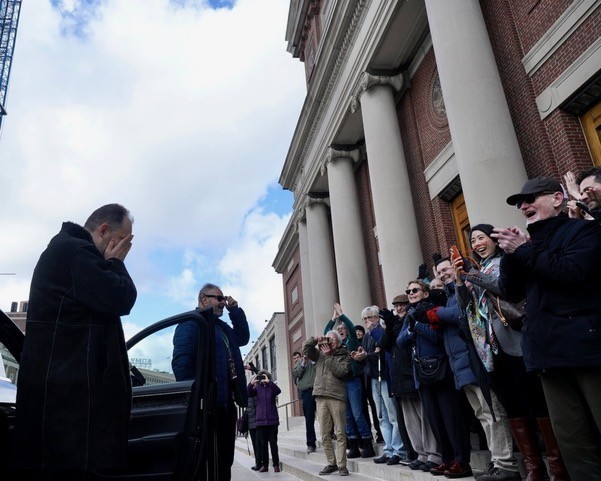
Follow-up: the Board of the BSO met with the orchestra members on March 17, 2026. Passionate speeches were made in support of Maestro Andris Nelsons, however, it was apparent the Board was united in its decision. Boston newspapers reported that, “Boston Trustees: We could explain but we won’t.” (See letters on this topic from Lincoln Russell and Eleanor Tillinghast in Reader to Reader.)
Editorial
The Egg
There’s this thing painted on the pavement at Red Lion corner. Stockbridge Updates has written about it before. It is shaped like an egg. It is right in the middle of the intersection. The paint was laid down so long ago and so many cars have driven over it –not knowing what it was there for – that it is now all but invisible.
What was it there for? To save lives, prevent injury to people and property. Think of it as a shrunken traffic circle.
Some time ago, we had studies about road safety in Stockbridge – speed limits through Town, potentially dangerous intersections, and possible solutions. Regardless of the statistics – how many accidents it requires for the Commonwealth to identify an intersection as dangerous – many folks just felt uneasy at the intersection of Main Street, Pine Street, and South Street (Red Lion corner).
There were meetings, discussions, and possible solutions posed. One group wanted a traffic light at that corner. Another group wanted a traffic circle. Well, the light was deemed “not Stockbridge” and a regulation-sized circle would take out a piece of the Civil War Memorial and the corner of the porch on the Red Lion. In short, the intersection was too small and there was no enthusiasm for a light.
Enter the engineers. They fashioned The Egg. It would function like a traffic circle. Exactly how is that? A circle reduces the possible points of impact while making the movement of traffic through the intersection more efficient and eliminating the need for stop signs. Sounds good. How does that work?
The shortest distance between two points is a straight line, right? So, without The Egg, when turning, everyone cuts across increasing the points of contact between cars. No one wants that – that is the definition of a traffic accident. If you go around The Egg, all cars always keeping The Egg on the left, there are fewer points of impact. As on a traffic circle, cars are following one another not crisscrossing.
What happened? We voted for The Egg and it was painted on the pavement as a test of its usefulness. No one explained it, no one understood it, everyone drove over it, and the paint faded. That is not what was meant to happen. The next step was to raise The Egg. The paint would be replaced with a raised egg shape on the pavement making crisscrossing impossible. Folks would feel safer because actually they would be safer. The Highway Department said they could raise The Egg with their current budget and staff.
So here is the question: what does our Town administration have against that corner? It was our Town Center — the intersection of Pine, Main, and South Streets to Elm Street. It was the Town center Norman Rockell painted and we celebrated. The Town center that millions of Americans know. Now it is an under-maintained, second-class citizen. We voted the money to maintain the courts on Pine Street, and Town administration chose not to spend it on the courts. Our Town had a contractual obligation to maintain the courts, and for years, it was not honored. Finally, due to neglect, the damage to the tennis courts was described as too expensive to undertake and we did not undertake it. The painted Egg was never raised – the mini traffic circle never created. What happened and where is our Town Center now?
Carole Owens
Executive Editor

by Carole Owens , Executive Editor
Sign Up for
Stockbridge Updates
Local news provided free of charge.
Past Issues
-
VOL. VII NO. 15 09/01/2026
-
VOL. VII NO. 14 07/15/2026
-
VOL. VII NO. 13 07/01/2026
-
VOL. VII NO. 12 06/15/2026
-
VOL. VII NO. 11 06/01/2026
-
VOL. VII NO. 10 05/15/2026
-
VOL. VII NO. 09 05/01/2026
-
VOL. VII NO. 08 04/15/2026
-
VOL. VII NO. 07 04/01/2026
-
VOL. VII NO. 06 03/15/2026
-
VOL. VII NO. 05 03/15/2026
-
VOL. VII NO. 04 03/01/2026
-
VOL. VII NO. 03 02/15/2026
-
VOL. VII NO. 02 01/15/2026
-
VOL. VII NO. 01 01/01/2026
-
VOL. VI NO. 22 10/15/2025
-
VOL. VI NO. 21 10/01/2025
-
VOL. VI NO. 20 09/21/2025
-
VOL. VI NO. 19 09/15/2025
-
VOL. VI NO. 18 09/01/2025
-
VOL. VI NO. 16 08/15/2025
-
VOL. VI NO. 15 08/01/2025
-
VOL. VI NO. 14 07/21/2025
-
VOL. VI NO. 13 07/15/2025
-
VOL. VI NO. 12 07/01/2025
-
VOL. VI NO. 11 06/15/2025
-
VOL. VI NO. 10 06/01/2025
-
VOL. VI NO. 09 05/15/2025
-
VOL. VI NO. 08 05/01/2025
-
VOL. VI NO. 07 04/01/2025
-
VOL. VI NO. 06 04/15/2025
-
VOL. VI NO. 05 03/15/2025
-
VOL. VI NO. 04 03/01/2025
-
VOL. VI NO. 03 02/15/2025
-
VOL. VI NO. 02 02/01/2025
-
VOL. VI NO. 01 01/15/2025
-
VOL. V NO. 22 11/15/2024
-
VOL. V NO. 21 11/01/2024
-
VOL. V NO. 20 10/15/2024
-
VOL. V NO. 19 10/01/2024
-
VOL. V NO. 18 09/15/2024
-
VOL. V NO. 17 09/01/2024
-
VOL. V NO. 16 08/15/2024
-
VOL. V NO. 15 08/01/2024
-
VOL. V NO. 14 07/15/2024
-
VOL. V NO. 13 07/01/2024
-
VOL. V NO. 12 06/15/2024
-
VOL. V NO. 11 06/01/2024
-
VOL. V NO. 10 05/15/2024
-
VOL. V NO. 09 05/01/2024
-
VOL. V NO. 08 04/15/2024
-
VOL. V NO. 07 04/01/2024
-
VOL. V NO. 06 03/15/2024
-
VOL. V NO. 05 03/01/2024
-
VOL. V NO. 04 02/15/2024
-
VOL. V NO. 03 02/01/2024
-
VOL. V NO. 02 01/15/2024
-
VOL. V NO. 01 01/01/2024
-
VOL. IV NO. 28 12/15/2023
-
VOL. IV NO. 27 12/01/2023
-
VOL. IV NO. 26 11/15/2023
-
VOL. IV NO. 25 11/01/2023
-
VOL. IV NO. 24 10/22/2023
-
VOL. IV NO. 23 10/15/2023
-
VOL. IV NO. 22 10/01/2023
-
VOL. IV NO. 21 09/22/2023
-
VOL. IV NO. 20 09/15/2023
-
VOL. IV NO. 19 09/08/2023
-
VOL. IV NO. 18 09/01/2023
-
VOL. IV NO. 17 08/22/2023
-
VOL. IV NO. 16 08/15/2023
-
VOL. IV NO. 15 08/01/2023
-
VOL. IV NO. 14 07/15/2023
-
VOL. IV NO. 13 07/01/2023
-
VOL. IV NO. 12 06/15/2023
-
VOL. IV NO. 11 06/01/2023
-
VOL. IV NO. 10 05/15/2023
-
VOL. IV NO. 09 05/01/2023
-
VOL. IV NO. 08 04/15/2023
-
VOL. IV NO. 07 04/01/2023
-
VOL. IV NO. 06 03/15/2023
-
VOL. IV NO. 05 03/11/2023
-
VOL. IV NO. 04 02/15/2023
-
VOL. IV NO. 03 02/01/2023
-
VOL. IV NO. 02 01/15/2023
-
VOL. IV NO. 01 01/01/2023
-
VOL. III NO. 24 12/15/2022
-
VOL. III NO. 23 12/01/2022
-
VOL. III NO. 22 11/15/2022
-
VOL. III NO. 21 11/01/2022
-
VOL. III NO. 20 10/15/2022
-
VOL. III NO. 19 10/01/2022
-
VOL. III NO. 18 09/15/2022
-
VOL. III NO. 17 09/01/2022
-
VOL. III NO. 16 08/15/2022
-
VOL. III NO. 15 08/01/2022
-
VOL. III NO. 14 07/15/2022
-
VOL. III NO. 13 07/01/2022
-
VOL. III NO. 12 06/15/2022
-
VOL. III NO. 11 06/01/2022
-
VOL. III NO. 10 05/15/2022
-
VOL. III NO. 09 05/01/2022
-
VOL. III NO. 08 04/15/2022
-
VOL. III NO. 07 04/01/2022
-
VOL. III NO. 06 03/15/2022
-
VOL. III NO. 05 03/01/2022
-
VOL. III NO. 04 02/15/2022
-
VOL. III NO. 03 02/01/2022
-
VOL. III NO. 02 01/15/2022
-
VOL. III NO. 01 01/01/2022
-
VOL. II NO. 24 12/15/2021
-
VOL. II NO. 23 12/01/2021
-
VOL. II NO. 22 11/15/2021
-
VOL. II NO. 21 11/01/2021
-
VOL. II NO. 20 10/15/2021
-
VOL. II NO. 19 10/01/2021
-
VOL. II NO. 18 09/15/2021
-
VOL. II NO. 17 09/01/2021
-
VOL. II NO. 16 08/15/2021
-
VOL. II NO. 15 08/01/2021
-
VOL. II NO. 14 07/15/2021
-
VOL. II NO. 13 07/01/2021
-
VOL. II NO. 12 06/15/2021
-
VOL. II NO. 11 06/01/2021
-
VOL. II NO. 10 05/15/2021
-
VOL. II NO. 09 05/01/2021
-
VOL. II NO. 08 04/15/2021
-
VOL. II NO. 07 04/01/2021
-
VOL. II NO. 06 03/15/2021
-
VOL. II NO. 05 03/01/2021
-
VOL. II NO. 04 02/15/2021
-
VOL. II NO. 03 02/01/2021
-
VOL. II NO. 02 01/15/2021
-
VOL. II NO. 01 01/01/2021
-
VOL. I NO. 10 12/15/2020
-
VOL. I NO. 09 12/01/2020
-
VOL. I NO. 08 11/13/2020
-
VOL. I NO. 07 11/01/2020
-
VOL. I NO. 06 10/18/2020
-
VOL. I NO. 05 10/01/2020
-
VOL. I NO. 04 09/15/2020
-
VOL. I NO. 03 09/01/2020
-
VOL. I NO. 02 08/18/2020
-
VOL. I NO. 01 08/06/2020